Computational Pharmacokinetics in Drug Development: A Critical, Question-Centered Review of Modeling Platforms, Validation, and Regulatory Applications
- aDepartment of Pharmacy, Malineni Perumallu Pharmacy College, Guntur, Andhra Pradesh, India
Corresponding author: guntupallir84@gmail.com
Abstract
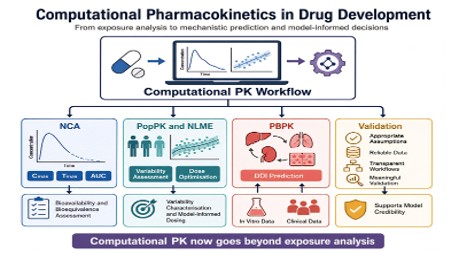
Computational pharmacokinetics (PK) has become an important component of modern drug development, extending beyond the description of drug exposure toward prediction, simulation, dose optimization, and support for regulatory decision-making. This critical, question-centered review examines how major computational approaches differ in their applications, data requirements, assumptions, and capacity to address specific drug-development questions. Conventional noncompartmental analysis remains useful for summarizing observed exposure and supporting comparative pharmacokinetic and bioequivalence studies. Population pharmacokinetic and nonlinear mixed-effects models provide a framework for characterizing interindividual variability, identifying influential covariates, evaluating external predictive performance, and supporting model-informed dosing. Programmable pharmacometrics further enables flexible model development, simulation, automation, and reproducible workflows through R-based and other computational environments. Physiologically based pharmacokinetic and mechanistic models provide a more detailed representation of drug disposition and are increasingly applied to drug-drug interaction assessment, special populations, bioequivalence, and clinical or regulatory extrapolation. Recent developments in high-throughput modeling, automated workflows, and applications to biologics, antisense oligonucleotides, cellular therapies, and antibody-drug conjugates are broadening the scope of computational PK. However, increasing model complexity does not necessarily ensure greater predictive value. Model credibility remains dependent on data quality, appropriate assumptions, transparent reporting, uncertainty assessment, and meaningful internal and external validation. Overall, computational PK is most informative when the modeling strategy is selected according to the scientific question and intended decision rather than the capabilities of a particular software platform. Future progress should emphasize reproducibility, standardized evaluation, external validation, and appropriate integration of emerging computational methods into drug-development practice
Graphical abstract
Keywords
- Pharmacokinetics
- Pharmacokinetic Software
- Pharmacometrics Modeling
- Population Pharmacokinetics
- Nonlinear Mixed-Effects Modeling
References
1. Jones HM, Rowland-Yeo K. Basic Concepts in Physiologically Based Pharmacokinetic Modeling in Drug Discovery and Development. CPT Pharmacometrics Syst Pharmacol. 2013;2:e63. https://doi.org/10.1038/psp.2013.41
2. Lesko LJ. Perspective on model-informed drug development. CPT Pharmacometrics Syst Pharmacol.2021;10(10):1127-9. https://doi.org/10.1002/psp4.12699.
3. Rayner CR, Smith PF, Andes D, Andrews K, Derendorf H, Friberg LE, et al. Model-informed drug development for anti-infectives: state of the art and future. Clin Pharmacol Ther. 2021;109(4):867-91. https://doi.org/10.1002/cpt.2198.
4. Rostami-Hodjegan A, Toon S. Physiologically based pharmacokinetics as a component of model-informed drug development: where we were, where we are, and where we are heading. J Clin Pharmacol. 2020;60(Suppl 1):S12-6. https://doi.org/10.1002/jcph.1654.
5. El-Khateeb E, Burkhill S, Murby S, Amirat H, Rostami-Hodjegan A, Ahmad A. Physiological-based pharmacokinetic modeling trends in pharmaceutical drug development over the last 20-years; in-depth analysis of applications, organizations, and platforms. Biopharm Drug Dispos.2021;42(5):163-74. https://doi.org/10.1002/bdd.2278.
6. Fidler M, Wilkins JJ, Hooijmaijers R, Post TM, Schoemaker R, Trame M, et al. Nonlinear mixed-effects model development and simulation using nlmixr and related R open-source packages. CPT Pharmacometrics Syst Pharmacol. 2019;8(9):621-33. https://doi.org/10.1002/psp4.12445.
7. U.S. Food and Drug Administration. Physiologically based pharmacokinetic analyses-format and content guidance for industry. Silver Spring (MD): FDA; 2018.
8. European Medicines Agency. Guideline on the reporting of physiologically based pharmacokinetic modelling and simulation. Amsterdam EMA; 2019. EMA/CHMP/458101/2016.
9. International Council for Harmonisation. M15 general principles for model-informed drug development. Geneva: ICH; 2026.
10. Kim H, Han S, Cho YS, Yoon SK, Bae KS. Development of R packages: ‘Non Com- part’and‘ncar’ for non compartmental analysis (NCA). Transl Clin Pharmacol. 2018;26(1):10-15 http://doi.org/10.12793/tcp.2018.26.1.10.
11. Shin W, Yang AY, Yun H, Cho DY, Park KH, Shin H, Kim A. Bioequivalence of the pharmacokinetics between tofacitinib aspartate and tofacitinib citrate in healthy subjects. Transl ClinPharmacol.2020;28(3):160-167. http://doi.org/10.12793/tcp.2020.28.e13.
12. Kuang Y, Song HL, Yang GP, Pei Q, Yang XY, Ye L, Yang S, Wu ST, Guo C, He QN, Huang J. Effect of high-fat diet on the pharmacokinetics and safety of flumatinib in healthy Chinese subjects. Cancer Chemother Pharmacol. 2020;86:339-346 http://doi.org/10.1007/s00280-020-04117-w
13. Chiang MD, et al. Plasma and cerebrospinal fluid pharmacokinetics of ondansetron in humans. Br J ClinPharmacol.2020;86. https://doi.org/10.1111/bcp.14412.
14. Chen YL, Tsukada H, Milanovic S, Shi L, Li Y, Mao Y, Koblan KS, Galluppi GR, et al. Comparative bioequivalence of tablet and capsule formulations of ulotaront and the effect of food on the pharmacokinetics of the tablet form in humans. Neurol Ther. 2023;12:815-832. http://doi.org/10.1007/s40120-023-00459-8.
15. Díaz-Tufinio CA, Gonzalez-Covarrubias V, Palma-Aguirre JA. Pharmacological parameters and pharmacokinetic variability derived from bioequivalence trials in a Mexican population. Clin Pharmacol Drug Dev. 2024;13(1):6-13. https://doi.org/10.1002/cpdd.1343.
16. Lee S, Kim B, Lee SH, Kang SH, Yu KS. Comparative pharmacokinetics and bioequivalence of 145-mg fenofibrate formulations in healthy Korean participants. Naunyn Schmiedebergs Arch Pharmacol. 2025;398(10):14461-6. https://doi.org/10.1007/s00210-025-04086-y.
17. Sözer G, Nacak M, Durucu E, Martin W, Reinsch M, Koru S, et al. Bioequivalence study of two formulations of lurasidone film coated tablets in healthy subjects under fed conditions. Sci Rep. 2025;15:20492. https://doi.org/10.1038/s41598-025-04800-z.
18. Song R, Wu X, Xin L, Sun C, Gui Y, Qian H, et al. Bioequivalence of water-soluble progesterone injection (GenSci070) in healthy Chinese postmenopausal women volunteers. Clin Ther. 2025;47(4):271-6. https://doi.org/10.1016/j.clinthera.2024.12.015.
19. Guntupalli R, Ravisankar P, Konidala SK. Development and validation of an LC-MS/MS method for Lazertinib in rat plasma using SFOD microextraction with pharmacokinetic application. Microchem J. 2026;226:118412. https://doi.org/10.1016/j.microc.2026.118412.
20. Guntupalli R, Ravisankar P, Konidala SK. Validated LC-MS/MS method for quantification and pharmacokinetic analysis of Talazoparib and Enzalutamide in rats. Biomed Chromatogr. 2026;40(3):e70381. https://doi.org/10.1002/bmc.70381.
21. Bukkems LH, Roger C, Hodiamont CJ, Lefrant JY, Juffermans NP, Roberts JA, et al. Predictive performance of a gentamicin population pharmacokinetic model in two western populations of critically ill patients. Int J Antimicrob Agents. 2018;52(6):822-8. https://doi.org/10.1016/j.ijantimicag.2018.04.016.
22. Wang YL, Guilhaumou R, Blin O, Velly L, Marsot A. External evaluation of population pharmacokinetic models for continuous administration of meropenem in critically ill adult patients. Eur J Clin Pharmacol. 2020;76(9):1281-9. https://doi.org/10.1007/s00228-020-02922-z.
23. Stillemans G, Belkhir L, Vandercam B, Vincent A, Haufroid V, Elens L. Optimal sampling strategies for darunavir and external validation of the underlying population pharmacokinetic model. Eur J Clin Pharmacol. 2021;77(4):607-16. https://doi.org/10.1007/s00228-020-03036-2.
24. Chan Kwong AHXP, Calvier EAM, Fabre D, Gattacceca F, Khier S. Prior information for population pharmacokinetic and pharmacokinetic/pharmacodynamic analysis: overview and guidance with a focus on the NONMEM PRIOR subroutine. J Pharmacokinet Pharmacodyn. 2020;47(5):431-46. https://doi.org/10.1007/s10928-020-09695-z.
25. Yu XB, Jiao Z, Zhang CH, Dai Y, Zhou ZY, Han L, et al. Population pharmacokinetic and optimization of polymyxin B dosing in adult patients with various renal functions. Br J Clin Pharmacol. 2021;87(4):1869-77. https://doi.org/10.1111/bcp.14576.
26. Lee DH, Kim HS, Park S, Lee SH, Kim HJ, et al. Population pharmacokinetics of meropenem in critically ill Korean patients and effects of extracorporeal membrane oxygenation. Pharmaceutics. 2021;13(11):1861. https://doi.org/10.3390/pharmaceutics13111861.
27. Sanches C, Alves GCS, da Silva SD, et al. Population pharmacokinetic model of piperacillin in critically ill patients and describing interethnic variation using external validation. Antibiotics (Basel).2022;11(4):434. https://doi.org/10.3390/antibiotics11040434.
28. Qin Y, Jiao Z, Ye YR, Shen Y, Chen Z, Chen YT, et al. External evaluation of the predictive performance of published population pharmacokinetic models of linezolid in adult patients. J Glob Antimicrob Resist. 2023;35:347-53. https://doi.org/10.1016/j.jgar.2023.08.003.
29. Črček M, Grabnar I, Aguiar Zdovc J, Grosek Š, Kerec Kos M. External validation of population pharmacokinetic models of gentamicin in paediatric population from preterm newborns to adolescents. Acta Pharm. 2023;73(2):175-94. https://doi.org/10.2478/acph-2023-0027.
30. Clewe O, Rekić D, Quartino AL, Carlsson B, Higashimori M, Wernevik L, et al. Population pharmacokinetics of a novel PCSK9 antisense oligonucleotide. Br J Clin Pharmacol. 2024;90(6):1503-13. https://doi.org/10.1111/bcp.16046.
31. Duong A, El Gamal A, Bilodeau V, Huot J, Delorme C, Poudrette J, et al. Vancomycin: an analysis and evaluation of eight population pharmacokinetic models for clinical application in general adult population. Pharmacotherapy. 2024;44(6):425-34. https://doi.org/10.1002/phar.2941.
32. Duan LF, Li JJ, Shen LR, Chen XL, Yu YX, Yang ZM, et al. Therapeutic drug monitoring of linezolid in Chinese premature neonates: a population pharmacokinetic analysis and dosage optimization. Antimicrob Agents Chemother. 2024;68(11):e01148-24. https://doi.org/10.1128/aac.01148-24.
33. Benavent E, Lora-Tamayo J, Ulldemolins M, Pons-Oltra P, Gregoire M, Mancheño-Losa M, et al. Efficacy, safety, and population pharmacokinetics of a single 1500 mg dose of dalbavancin for short-term therapy in patients with chronic prosthetic joint infections. Antimicrob Agents Chemother. 2025;69(12):e00773-25. https://doi.org/10.1128/aac.00773-25.
34. Francke MI, Sassen SDT, Lloberas N, Colom H, Elens L, Moudio S, et al. A population pharmacokinetic model and dosing algorithm to guide the tacrolimus starting and follow-up dose in living and deceased donor kidney transplant recipients.Clin Pharmacokinet. 2025;64(9):1379-94. https://doi.org/10.1007/s40262-025-01533-0.
35. Wu F, Zhou J, Zheng X, Masilamani M, Cheng Y, Caia A, et al. Population cellular kinetics of idecabtagene vicleucel in patients with triple-class-exposed relapsed/refractory multiple myeloma. Clin Pharmacokinet. 2025;64(7):1119-32. https://doi.org/10.1007/s40262-025-01531-2.
36. Elmokadem A, Riggs MM, Baron KT. Quantitative systems pharmacology and physiologically-based pharmacokinetic modeling with mrgsolve: a hands-on tutorial. CPT Pharmacometrics Syst Pharmacol. 2019;8(12):883-893. http://doi.org/10.1002/psp4.12467
37. Mak IM, Kamei K, et al. Development and application of R-based pharmacometric workflows for nonlinear mixed-effects modeling. CPT Pharmacometrics Syst Pharmacol. 2023;89(1):330-339.http://doi.org/10.1111/bcp.15496
38. Liu J, Wang Y, Zhao P, et al. A workflow for reproducible population pharmacokinetic modeling using R-based tools. CPT Pharmacometrics Syst Pharmacol. 2022;11 [conference abstract (Abstract 10210).]
39. Nordgren R, Hooker AC, Karlsson MO. Pharmpy: an open-source platform for pharmacometric modeling and analysis. CPT Pharmacometrics Syst Pharmacol. 2023;12. [conference abstract]
40. Fidler M, Wilkins JJ, Kannan S, et al. Pumas: a probabilistic programming platform for pharmacometrics. CPT Pharmacometrics Syst Pharmacol.2023;12(4):536-48. http://doi.org/10.1002/psp4.12866
41. Huang Q, et al. Automated population pharmacokinetic model development and evaluation using R-based workflows. CPT Pharmacometrics Syst Pharmacol. 2023.
42. Duong A, Marsot A. External evaluation of nlmixr2 and NONMEM population pharmacokinetic models using clinical data. CPT Pharmacometrics Syst Pharmacol. 2024.
43. Xu N, Shi Y, Wang Y, Mak W, Yang W, Ng KW, Wu Y, Tang Z, He Q, Yan G, Xiang X, Zhu X. Development and quality control of a population pharmacokinetic model library for caspofungin. Pharmaceutics. 2024;16(6):819. http://doi.org/10.3390/pharmaceutics16060819
44. Bunn H, Schentag C, Brandão LR, Ivaturi V, Lewis T. Pharmacokinetic model-guided enoxaparin dosing in the Neonatal ICU: Retrospective cohort study to plan for prospective feasibility trial. Clinical and Translational Science.2024;17(10):e70040. http://doi.org/10.1111/cts.70040
45. Marsousi N, et al. Physiologically based pharmacokinetic modeling of drug-drug interactions involving CYP-mediated metabolism.2018. http://doi.org/10.1002/bdd.2107
46. Chen Y, Zhu R, Ma F, Mao J, Chen EC, Choo EF, Sahasranaman S, Liu L. Assessment of OATP transporter-mediated drug-drug interaction using physiologically-based pharmacokinetic (PBPK) modeling-a case example. Biopharm Drug Dispos. 2018;39(9):420-430. http://doi.org/10.1002/bdd.2159
47. Wu F, Krishna G, Surapaneni S. Physiologically based pharmacokinetic modeling to assess metabolic drug-drug interaction risks and inform the drug label for fedratinib. Cancer Chemother Pharmacol.2020;86:461-473. http://doi.org/10.1007/s00280-020-04131-y
48. Bolleddula J, Ke A, Yang H, Prakash C. PBPK modeling to predict drug-drug interactions of ivosidenib as a perpetrator in cancer patients and qualification of the Simcyp platform for CYP3A4 induction. CPT Pharmacometrics Syst Pharmacol.2021;10(6):577-588. http://doi.org/10.1002/psp4.12619
49. Frechen S, et al. Physiologically based pharmacokinetic modeling for regulatory applications and drug labeling. 2021 http://doi.org/10.1002/psp4.12636
50. Bego M, Patel N, Cristofoletti R, Rostami-Hodjegan A. Proof of Concept in Assignment of Within-Subject Variability During Virtual Bioequivalence Studies: Propagation of Intra-Subject Variation in Gastrointestinal Physiology Using Physiologically Based Pharmacokinetic Modeling.AAPSJ.2022;24(1):21. http://doi.org/10.1208/s12248-021-00672-z
51. Morita T, Hanada K. Physiologically based pharmacokinetic modeling of ponatinib and prediction of drug-drug interactions. 2022. http://doi.org/10.1007/s00280-022-04466-8
52. Prieto Garcia L, et al. Cross-platform evaluation of physiologically based pharmacokinetic models. 2022. http://doi.org/10.1002/psp4.12837
53. Gajewska M, Przybyłek M, et al. Physiologically based pharmacokinetic modeling of alpelisib usingGastroPlus2020;22(6):134.. http://doi.org/10.1208/s12248-020-00511-7
54. Zhang Y, et al. Physiologically based pharmacokinetic modeling of NH130 using GastroPlus.2024;15:1474868. http://doi.org/10.3389/fphar.2024.1474868
55. Geci M, et al. High-throughput physiologically based kinetic modeling using PK-Sim. 2024;98(8):2659-2676. http://doi.org/10.1007/s00204-024-03764-9.
56. De Sutter PJ, Gasthuys E, Vermeulen A. Comparison of monoclonal antibody disposition predictions using different physiologically based pharmacokinetic modelling platforms. J Pharmacokinet Pharmacodyn. 2024;51(6):639-651. http://doi.org/10.1007/s10928-023-09894-4
57. Choules MP, Otsuka Y, Nielsen JC, Iwai M, Bonate PL. Physiologically based pharma- cokinetic model to predict the magnitude of drug-drug interaction between fezolinetant and CYP1A2 inhibitors. JClin Pharmacol. 2025;65(9) 1096-1105. https://doi.org/10.1002/jcph.70024.
Competing interests
The authors declare no competing interests.
How to Cite
License
Copyright (c) 2026 Rajesh Guntupalli, Darla Swarna Latha, Govinda Rao Yedlapalli, Guntupalli Venukumari

This work is licensed under a Creative Commons Attribution 4.0 International License.